
International family trips can go sideways long before you reach the airport. A child’s passport may expire sooner than you expected, one parent may need a consent letter for solo travel with a minor, or a destination may require visas or proof of onward travel that you did not realize applied to your family. A strong family travel document checklist helps you catch those issues early, before booking nonrefundable plans or scrambling the week of departure.
This guide is for U.S. parents planning international travel with children. It focuses on what to verify for each traveler, where to confirm rules through official sources, and how to build a reusable checklist you can use for future trips. The goal is not to replace country-specific guidance, but to help you organize the moving parts so your family is prepared.
Start With a Traveler-by-Traveler Document Inventory
The easiest mistake is assuming the family is covered because one adult has everything in order. International travel requirements apply to each person individually, including infants and children. Before you book or finalize your itinerary, make a simple inventory for every traveler in your group.
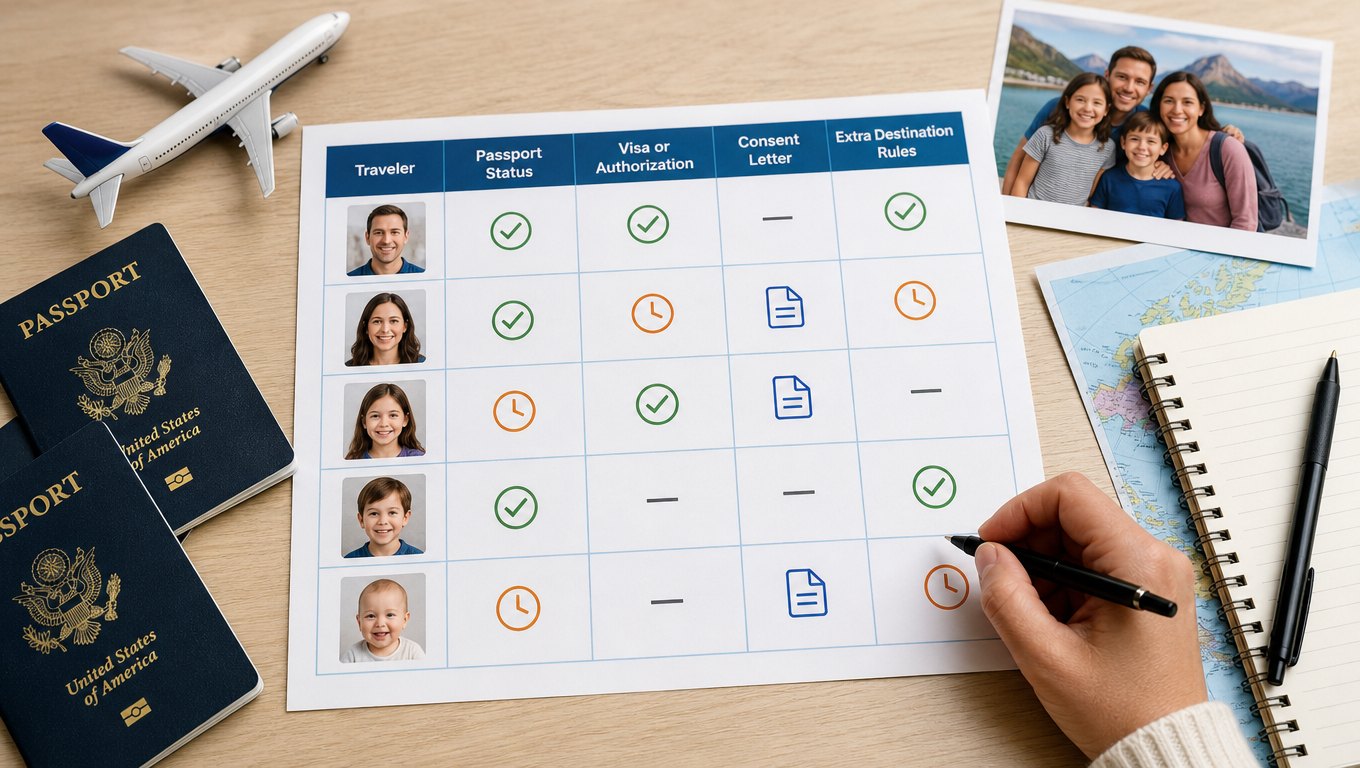
For each adult and child, use a name or initials your family recognizes, then note the passport expiration date and issuing country. When you book, check that the full legal name matches the passport exactly. Keep passport numbers and dates of birth out of the shared checklist. Then add whether that person may need a visa, travel authorization, or extra documents based on the destination or travel plan.
This matters because families often discover mismatches only when checking in. For example, a parent may book a ticket under a nickname while the passport shows a longer legal first name, or one child may have a passport that expires much earlier than everyone else’s. A traveler-by-traveler review makes those problems visible early enough to fix them.
A practical way to do this is to keep one shared checklist with a separate line for each person. Include:
- Passport in hand
- Passport valid long enough for the trip
- Visa or entry authorization needed or not needed
- Consent letter needed or not needed
- Any destination-specific health, entry, or minor travel documents
- Copies stored securely
If you travel more than once a year, save this as a reusable template rather than rebuilding it for every trip.
Check Passports Early, Not Just Before Departure
For most families, passports are the first and most obvious item on a family travel document checklist. They are also one of the biggest sources of last-minute stress.
Start by confirming that every traveler has a valid passport, including every child. Children cannot travel internationally on a parent’s passport. Then check the expiration date for each passport well before booking and again before departure.
Do not assume a passport is acceptable just because it will still be valid on your return date. Some destinations and airlines expect additional validity beyond the trip itself. Families often miss this when one passport in the group is fine but another child’s passport falls short.
You should also confirm that the passport is in good physical condition. Damage, missing pages, or major wear can create problems during travel. If anything looks questionable, it is better to investigate early than to hope it will be accepted.
If your family already uses separate reminders for school schedules, camp forms, and pediatric appointments, add passport expiration dates to that same system. A shared calendar reminder six to nine months before expiration can help prevent a future emergency, especially since children’s passports expire more often than adult passports.
Verify Visa and Entry Rules From Official Sources
Visa needs can vary by destination, nationality, trip purpose, and length of stay. Even within one family, requirements may differ if family members hold different passports. That is why a good family travel document checklist should include a step to verify entry rules from official government sources for the specific destination.
Start with the destination country’s official immigration, consular, or embassy website. Then cross-check with relevant U.S. government travel resources where appropriate. The point is to confirm current requirements directly, not to rely on forum posts, old blog articles, or assumptions from a past trip. If your destination is one the site already covers, a country-specific visa guide can also help you organize what to verify before you book.
As you review requirements, look for answers to these questions:
- Does each traveler need a visa, e-visa, or electronic travel authorization?
- Are there different rules for minors?
- Are there minimum passport validity rules?
- Is proof of onward or return travel required?
- Are there rules related to hotel reservations, address information, or entry forms?
- Are there any transit-country requirements if you have a layover?
This step matters because “we’re only connecting there” or “we’re staying less than a week” does not always remove document requirements. Even a straightforward family vacation can run into problems if a transit point or destination has its own entry form, authorization system, or documentation rule.
If your trip includes more than one country, repeat this review for every stop, not just the final destination.
Understand When a Child Travel Consent Letter May Help
One of the most overlooked parts of a family travel document checklist is the child travel consent letter. Rules can vary depending on the country, airline, and family situation, but parents should pay close attention whenever a minor is traveling with only one parent, with another adult, or without both parents.
A consent letter can help show that the child has permission to travel internationally. In some cases, it may reduce questions at border control or airline check-in. It can be especially useful for separated parents, blended families, grandparents traveling with children, school or sports trips, or any situation where the traveling adult does not share the same last name as the child.
Because requirements are not one-size-fits-all, families should verify expectations through official government sources and, when relevant, get legal guidance for their situation. It is better to find out in advance whether supporting documents may help than to face uncertainty at the airport.
As part of your planning, ask:
- Is the child traveling with both parents, one parent, or another adult?
- Do the child and accompanying adult have different last names?
- Will border officials reasonably expect proof of parental permission?
- Are there custody orders or other legal documents that may need to be carried?
If any of those questions raise uncertainty, put consent documentation on your checklist early rather than treating it as an optional afterthought.
Watch for Destination-Specific Rules Beyond Passports and Visas
Families often focus on passports and visas but overlook destination-specific rules that can still affect boarding or entry. These may include arrival forms, proof of accommodation, vaccination or health documentation requirements, or local rules for traveling with minors.
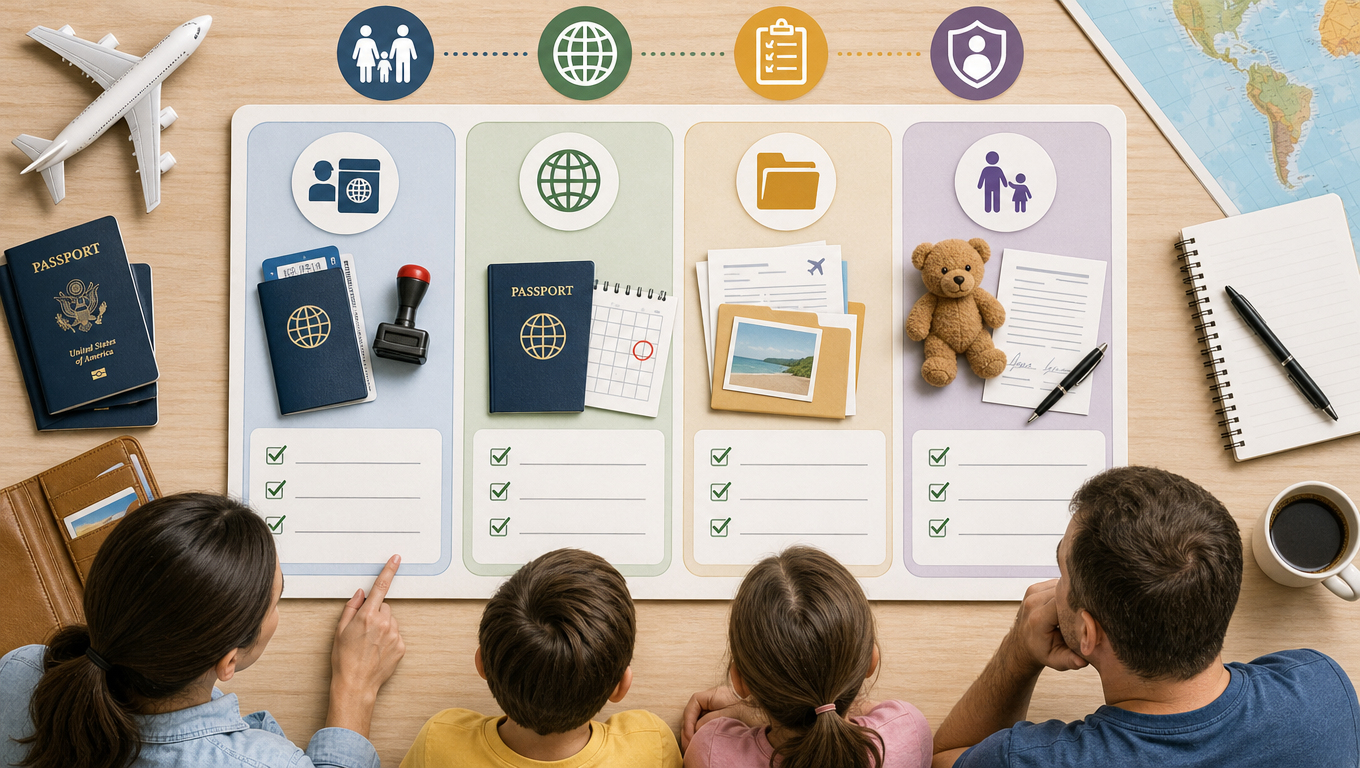
This is where a reusable family travel document checklist becomes especially valuable. Instead of treating every trip as only a passport question, you create a consistent habit of checking the full set of entry conditions.
For example, one destination may expect advance traveler registration, while another may pay closer attention to onward travel plans or the documentation carried by a solo parent traveling with a child. The exact requirement can change by country, so the most reliable approach is to review the destination’s official guidance for your travel dates.
A helpful framework is to divide destination rules into four categories:
- Entry permission: visa, waiver, or electronic authorization
- Validity rules: passport expiration window and blank pages if applicable
- Supporting proof: return ticket, hotel details, or local contact information if required
- Minor-specific rules: consent letters or other documents for children
That framework keeps your research organized and makes it easier to compare what applies to each family member.
Keep Digital and Paper Copies, But Store Them Carefully
Original documents usually matter most, but backups can still save time and reduce stress if something is lost or questioned during travel. Once your family travel document checklist is complete, create a copy plan. It can also help to know what to do quickly if a passport goes missing during a trip.
Store clear digital copies of passports, visas, consent letters, and key reservation details in a secure location you can access while traveling. Some families prefer an encrypted cloud folder; others use a secure password manager or a protected device folder. The best system is the one you can still reach if your bag, phone, or internet access becomes a problem.
Paper copies can also be useful, especially if one adult carries the originals and another adult carries a backup set separately. If your family is splitting up during parts of the trip, make sure the relevant adult has the relevant child’s information.
The reason this matters is simple: replacement and troubleshooting are easier when you can quickly produce passport details, travel dates, and supporting documentation. Copies are not a substitute for original documents, but they can make a difficult situation more manageable.
Build a Timeline So Nothing Slips to the Last Minute
A checklist works best when it is tied to a timeline. Families are managing work, school calendars, childcare, and packing, so document tasks should not all land in the final week.
A practical planning sequence looks like this:
Before Booking
Check every traveler’s passport status and expiration date. Review the destination’s official entry and visa rules. Identify any likely minor travel documentation issues, such as solo-parent travel or name differences.
Several Weeks or Months Before Departure
Apply for any needed passports, renewals, visas, or travel authorizations. Gather consent letters or supporting family documents if they may be relevant. Recheck official guidance if the destination updates entry rules.
One to Two Weeks Before Departure
Confirm that originals are packed and easy to access. Save digital backups. Review names on tickets against passports. Double-check transit points and return requirements.
The Day Before Travel
Do one final pass through your family travel document checklist. Each traveler should have the correct passport, and the adult carrying the documents should know where everything is.
This timeline matters because some problems can be solved only with lead time. A missing consent letter or outdated passport is much easier to handle weeks ahead than during online check-in.
A Simple Reusable Family Travel Document Checklist
If you want one working list to use trip after trip, keep it short enough to use and detailed enough to catch problems. A good baseline checklist for U.S. parents includes:
- Confirm every traveler has a valid passport
- Check passport expiration dates for each adult and child
- Review destination and transit-country entry rules on official government sites
- Confirm whether any traveler needs a visa or travel authorization
- Check whether a child travel consent letter may be needed
- Gather any additional minor travel or custody-related documents if relevant
- Review destination-specific entry forms or supporting proof requirements
- Match ticket names to passport names exactly
- Create secure digital copies of key documents
- Carry organized paper backups if useful for your family
- Recheck requirements shortly before departure
You can keep this as a note in your phone, a shared family travel spreadsheet, or a printable folder checklist. The format matters less than the habit of reviewing it for each trip.
Final Thought: Use Official Sources Early and Treat the Checklist as a Family System
The best family travel document checklist is not just a packing list. It is a planning system that helps parents verify what each traveler needs, spot issues while there is still time to fix them, and avoid preventable travel stress.
If your family travels internationally even occasionally, save your checklist and refine it after each trip. Add reminders for passport expirations, note which official sources were most useful, and update the template for situations like solo-parent travel, multi-country itineraries, or travel with grandparents.
That small amount of organization can make future planning much easier. More important, it can help your family get to the airport confident that the document side of the trip is already handled.
Never Miss a Travel Deadline
ExpireBuddy tracks your entire family's travel documents and alerts you when renewals are needed—well before your trip.
- ✓ Check travel eligibility for any destination
- ✓ Track passports for whole family
- ✓ Get alerts before deadlines
- ✓ Works offline while traveling